HELICON CONSULTING

Engineering services

CFD, FEM, thermal analysis, mechanical design, scanning and CAD reconstruction. The service areas below show the types of engineering questions I can investigate and the work delivered.

Technical focus: fluid mechanics · thermal analysis · structural engineering · 3D reconstruction

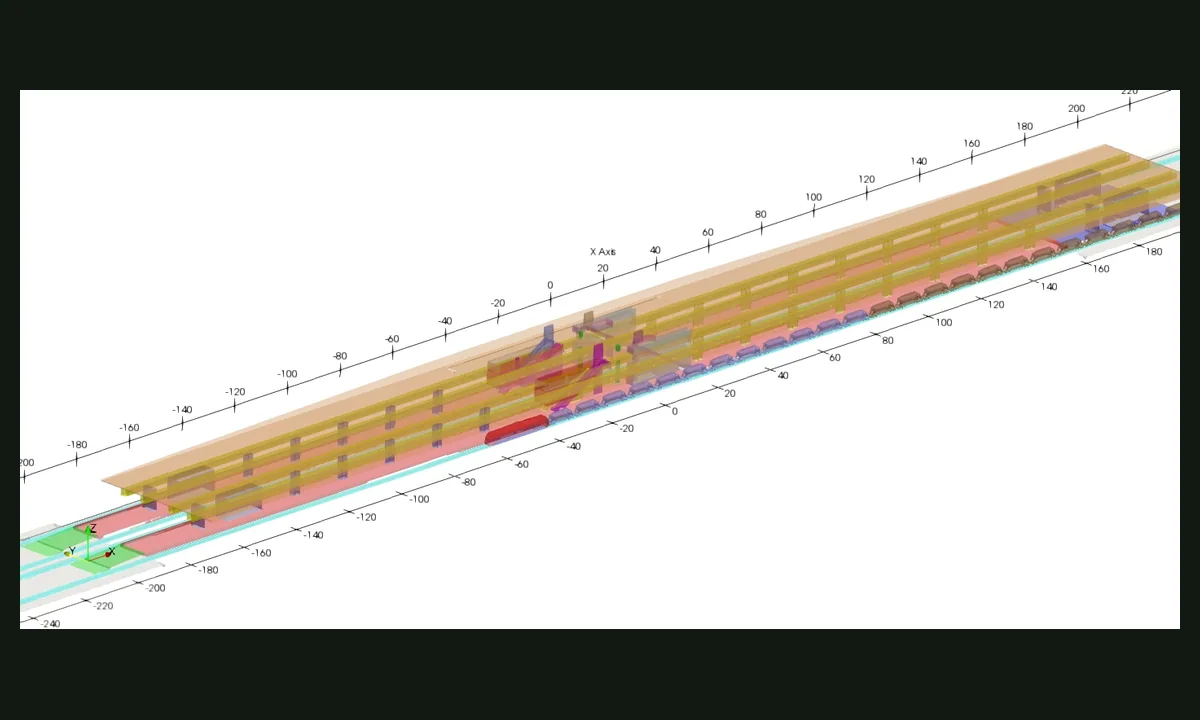
Underground-station CFD pollutant dispersion visualization
Industrial ventilation · CFD case study
Service details

Scope of work and deliverables

Each study is defined around a specific question, available input data, operating conditions and the accuracy required.

01 / Fluid systems

Fluid Systems & Industrial Equipment

Assess pressure losses, flow distribution and operating conditions in industrial systems. Compare proposed changes where appropriate.

Common engineering requests
  • Estimate and reduce pressure losses in ducts, manifolds and flow passages.
  • Correct uneven flow distribution across branches and equipment.
  • Evaluate fans, blowers, turbines and related flow components.
  • Investigate ventilation, filtration, mixing and reactor flow behavior.
What you receiveFlow and pressure assessments, comparison of operating conditions, identified performance limitations and documented design recommendations.
Typical client inputs

Drawings or CAD; fluid properties; flow rates; operating pressures; fan/pump characteristics or measured pressure loss, where available.

Technical approach and modelling methods

CAD and geometry assessment; CFD modelling in OpenFOAM, STAR-CCM+ or ANSYS Fluent as appropriate; turbulence-model selection; mesh and boundary-condition review; comparative studies and technical reporting.

Discuss a fluid-flow problem ↗
02 / Aerodynamics and hydrodynamics

Aerodynamics & Hydrodynamics

Calculate lift, drag, pressure and external-flow loads. Compare operating conditions or geometry variants as required.

Common engineering requests
  • Assess lift, drag and pressure distributions across operating conditions.
  • Investigate flow separation and aerodynamic or hydrodynamic losses.
  • Compare design configurations and geometric modifications.
  • Evaluate wind loads and external-flow behavior around products and structures.
What you receiveForce and moment estimates, aerodynamic or hydrodynamic performance comparisons, flow interpretation, and recommendations for design refinement.
Typical client inputs

Geometry, reference dimensions, velocity/operating envelope, force targets, relevant wind-tunnel or test measurements if available.

Related experience and applications
Technical approach and modelling methods

External-flow CFD; geometry preparation; near-wall resolution and meshing; suitable turbulence or transition modelling; operating-condition sweeps; force integration, sensitivity assessments and verification of numerical assumptions.

Discuss an aerodynamic or marine component ↗
03 / Cooling and heat transfer

Cooling & Thermal Management

Estimate temperatures and heat transfer, investigate hot spots and compare cooling layouts against the available loads and constraints.

Common engineering requests
  • Identify hot spots and insufficient cooling in enclosures and equipment.
  • Evaluate electronics and battery thermal performance.
  • Compare heat exchangers, cold plates and cooling-channel layouts.
  • Assess coupled heat transfer between solids and moving fluids.
What you receiveTemperature predictions, heat-transfer assessments, cooling performance comparisons and engineering guidance on thermal constraints and design options.
Typical client inputs

Geometry, materials, heat sources, boundary temperatures, flow rates, coolant properties and thermal/pressure measurements where available.

Technical approach and modelling methods

Heat-load and boundary-condition review; thermal resistance estimates; conduction and conjugate heat transfer analysis; airflow and liquid-cooling CFD; model-checking and practical operating-case studies.

Discuss a cooling or temperature problem ↗
04 / Mechanical design and verification

Mechanical Design & Product Validation

Assess stress, deflection and component performance under defined loads. Review geometry or material changes where needed.

Common engineering requests
  • Estimate stress, stiffness and deflection under specified loading.
  • Review a component before manufacture or installation.
  • Compare material, geometry and weight-reduction alternatives.
  • Investigate mechanical shortcomings and temperature-induced deformation.
What you receiveStructural response estimates, identified critical regions, defined assumptions and verification checks, and documented recommendations for design decisions.
Typical client inputs

CAD, drawings, materials, supports, applied loads, operating temperatures and any measured deformations or test observations.

Technical approach and modelling methods

CAD modelling and design review; finite-element analysis in appropriate engineering software; load-case definition; mesh-convergence and boundary-condition checks; geometry refinement and technical documentation.

Discuss a mechanical design ↗
05 / 3D scanning and reconstruction

3D Scanning & Reverse Engineering

Scan existing parts and reconstruct surfaces or solids for CAD modification, analysis or manufacture.

Common engineering requests
  • Digitize parts, assemblies and complex existing surfaces.
  • Rebuild usable CAD geometry from scan data or legacy components.
  • Reconstruct missing, damaged or inaccessible geometric features.
  • Prepare and adapt geometry for engineering analysis or redesign.
What you receiveAgreed scan deliverables, reconstructed surfaces or solids, checked geometric features, CAD files and documentation of reconstruction assumptions.
Typical client inputs

Photographs, part size, access conditions, desired CAD format, relevant tolerances and the intended manufacturing or analysis use.

Related experience and applications
Technical approach and modelling methods

Professional structured-light 3D scanning using an Artec Eva; scan alignment and cleanup; feature fitting; surfacing and CAD reconstruction; geometry validation and export for engineering workflows.

Discuss a reverse-engineering project ↗
Across all five services

Additional engineering capabilities

Optimization, troubleshooting, custom numerical modelling and automation can be included where they are relevant to the project scope.

Design optimization

Evaluate geometry or operating-condition changes against defined performance requirements.

Troubleshooting

Investigate possible causes of poor performance and compare corrective options.

Custom numerical modelling

Develop or adapt numerical methods when standard tools do not adequately represent the problem.

Simulation automation

Automate repeatable setup, runs and post-processing for parameter studies and repeated analyses.

Project delivery

Scope, analysis and reporting

Scope, inputs, modelling assumptions, cases and deliverables are agreed before the study begins.

01 / DEFINE

Define the scope

Review the inputs, agree on the cases to evaluate, and define acceptance criteria.

02 / INVESTIGATE

Run and check the analysis

Prepare the model, check the setup, and run the agreed operating or design cases.

03 / DECIDE

Document the results

Provide the results, comparisons, assumptions, limitations and recommendations in a technical report.

SPECIALIST SUPPORT FOR DESIGN TEAMS

Subcontracted CFD and engineering analysis

I support engineering consultancies and design teams with defined numerical-analysis, CAD reconstruction and technical-review packages. I can work within existing geometry and reporting workflows, with agreed handovers, technical checkpoints and confidentiality terms.

Defined responsibility and deliverables

Schedule, capacity, review points and change control are established in the proposal—not assumed across all projects.

Discuss a subcontracting requirement →

ENGAGEMENT OPTIONS

Agree the initial scope before the study

The appropriate first phase depends on the available information and the engineering decision required. Fees, schedule and deliverables are defined in the proposal.

Initial technical assessment

Review the geometry, requirements and available measurements. Identify likely causes, missing inputs and whether a detailed study is justified.

Detailed investigation

Complete specified numerical or analytical cases, appropriate verification and sensitivity checks, and a technical report of assumptions and findings.

Design comparison

Assess agreed alternatives using consistent performance criteria and document their trade-offs and limitations.

CLIENT FEEDBACK

Client reviews

Selected feedback from previous Upwork engineering contracts.

★★★★★
“Great communication and high quality of work.”
Upwork client review · 5.0/5
★★★★★
“Amazing CFD skills. Definitely will hire again.”
Upwork client review · 5.0/5
Start a conversation

Describe your project

Start with the product or system, operating conditions and the question the study needs to answer.

For confidential projects, begin with a non-sensitive summary. Technical files and NDA requirements can be discussed before sharing project information.

Start with a non-confidential summary

Explain the system, operating conditions, available geometry or measurements, and the decision you need to make. Technical files can be exchanged later through an agreed channel.

Send an engineering enquiry →